History of Tata Motors: From 1945 to 2026
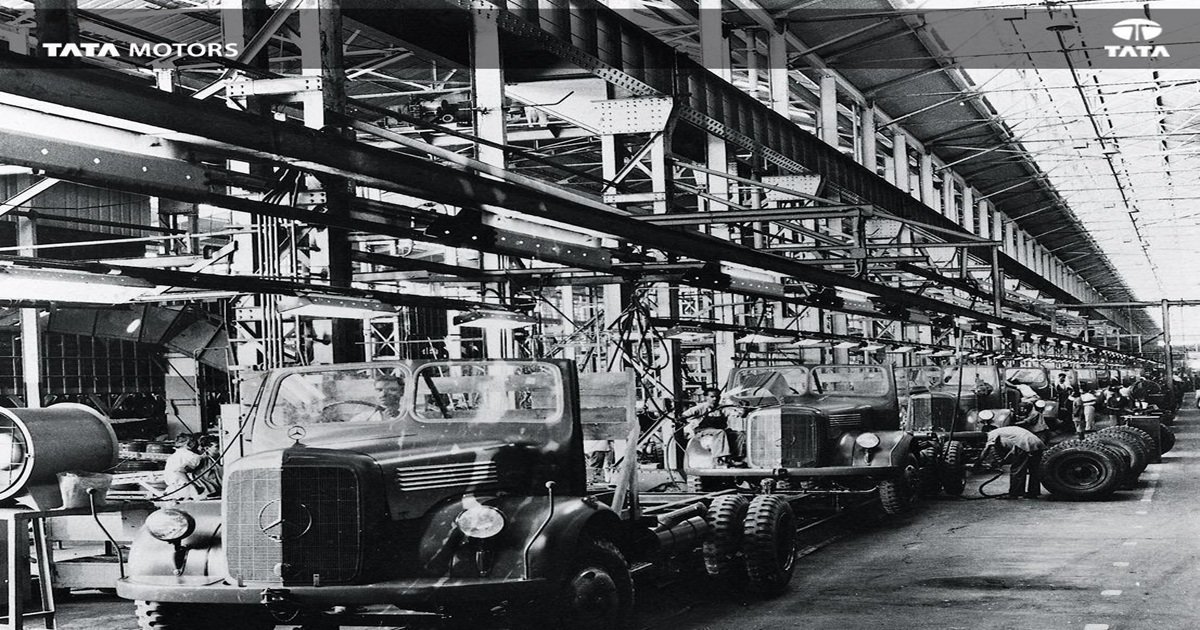
Tata Motors is one of India's most prominent automobile manufacturers, with a history spanning more than eight decades. Founded in 1945 as Tata Locomotive and Engineering Company (TELCO), the company began by producing locomotives and engineering equipment before expanding into trucks, passenger cars, SUVs, buses, and electric vehicles.
Tata Motors+1
Its journey reflects the growth of India's automotive industry, from early industrial manufacturing to modern mobility technology and global expansion.
1. The beginning: 1945

Tata Motors was established on September 1, 1945, under the name Tata Locomotive and Engineering Company, commonly known as TELCO.
Under the vision of J. R. D. Tata, the company initially focused on locomotives, boilers, road rollers, and heavy engineering products. Its early work contributed to India's industrial development during the years surrounding independence.
In 1948, the company introduced steam road rollers, marking an early milestone in its manufacturing journey.
2. Entering the truck industry: 1954

A major turning point arrived in 1954, when Tata partnered with Germany's Daimler-Benz to manufacture commercial vehicles in India.
The partnership led to the production of Tata's first commercial trucks, helping establish a foundation for India's domestic truck manufacturing industry.
Over time, Tata vehicles became familiar on Indian highways, construction sites, farms, and industrial transport routes.
3. The rise of Indian trucks: 1970s–1980s

During the 1970s and 1980s, Tata Motors strengthened its position in commercial transportation.
- 1975: The Tata 1210 semi-forward truck became an important milestone.
- 1983: Manufacturing of heavy commercial vehicles expanded.
- 1986: The Tata 407 light commercial vehicle was introduced, becoming one of the company's best-known vehicles.
- 1988: The Tata Mobile pickup truck entered the market.
These developments helped Tata build a strong reputation in India's transport and logistics industries.
4. Entering the passenger-car market: 1991–1998

The 1990s marked a major change in Tata Motors' ambitions. The company began moving beyond trucks into passenger vehicles.
- 1991: Tata Sierra was introduced as an indigenously developed passenger vehicle.
- 1994: Tata Sumo became a popular multi-utility vehicle.
- 1998: Tata Indica was launched as India's first indigenously developed passenger car.
- 1998: Tata Safari entered the market and became one of the company's iconic SUVs.
The Indica was particularly significant because it demonstrated that an Indian manufacturer could develop a passenger car designed around the needs of Indian customers.
5. Global expansion: 2000–2008

At the beginning of the new millennium, the company accelerated its growth and international expansion.
- 2003: The company adopted the name Tata Motors Limited.
- 2004: It acquired Daewoo Commercial Vehicle Company in South Korea and listed on the New York Stock Exchange.
- 2005: Tata Ace, popularly known as the “Chhota Hathi,” transformed small-scale goods transportation.
- 2008: Tata Motors acquired Jaguar Land Rover from Ford, giving it ownership of two renowned British automotive brands.
The Jaguar Land Rover acquisition was a defining moment, taking Tata Motors onto a much larger global stage.
6. Tata Nano and the affordable-car vision: 2009

In 2009, Tata Motors launched the Tata Nano, a compact car developed with the ambition of making four-wheel personal transportation more affordable for Indian families.
Although the Nano attracted enormous attention, it did not achieve the long-term commercial success originally envisioned. Nevertheless, it remains an important chapter in the company's history of affordable vehicle engineering.
7. Modern design and electric vehicles: 2010–2024

- 2016: Tata Tiago helped introduce the company's newer design direction.
- 2018: The company presented its ALFA and OMEGA vehicle architectures.
- 2019: Tata Nexon EV was launched, marking a major step in its electric-car strategy.
- 2020: Tata Motors completed its transition to BS VI emission standards.
- 2023: It acquired Ford India's Sanand manufacturing plant, creating opportunities for additional production capacity.
Electric vehicles became an increasingly important part of the company's long-term plans as India moved toward cleaner mobility.
8. Tata Motors in 2025 and 2026

Tata Motors marked 80 years since its founding in 2025. That year also brought a major corporate restructuring: its commercial-vehicle and passenger-vehicle businesses were separated into distinct listed companies, each able to pursue its own strategic priorities.
In 2026, Tata Motors Passenger Vehicles unveiled a new global brand identity, TATA.CARS, reflecting its evolving passenger-car business.
9. Conclusion
From manufacturing locomotives in 1945 to developing trucks, passenger cars, luxury vehicles, and electric mobility solutions, Tata Motors has played a significant role in India's automotive journey.
Its history includes landmark vehicles such as the Tata 407, Indica, Safari, Ace, and Nexon EV, along with the global expansion achieved through Jaguar Land Rover. The company's story is one of engineering ambition, changing customer needs, and continuous transformation.
0 comments